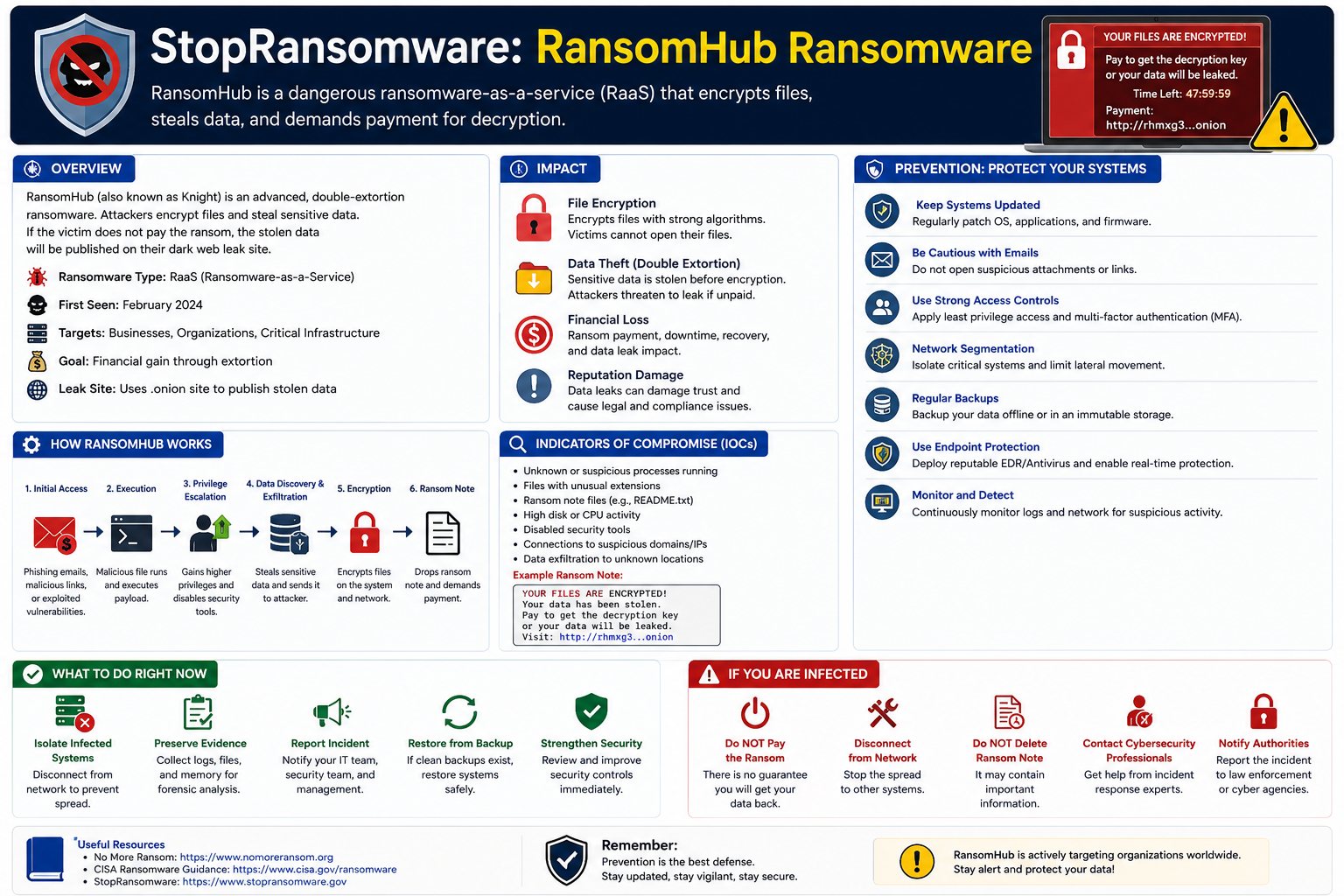
StopRansomware: RansomHub Ransomware
Overview
RansomHub is a ransomware-as-a-service (RaaS) operation that encrypts victims’ files and demands payment for decryption. It is known for using “double extortion,” where attackers both encrypt data and steal sensitive files before demanding ransom.
Organizations, businesses, and critical infrastructure are common targets.
What is RansomHub?
RansomHub is a cybercriminal ransomware group that:
- Encrypts files and systems
- Steals confidential data
- Demands cryptocurrency payment
- Threatens to leak stolen information publicly
The ransomware is usually distributed through:
- Phishing emails
- Malicious attachments
- Exploited vulnerabilities
- Compromised remote access services
- Stolen credentials
How RansomHub Works
1. Initial Access
Attackers gain access through:
- Fake emails
- Weak passwords
- VPN vulnerabilities
- Remote Desktop Protocol (RDP)
Example:
Fake invoice email with malicious attachment2. Execution
Malware executes on the victim’s system and begins running malicious commands.
The attacker may install:
- Backdoors
- Remote access tools
- Credential stealers
3. Privilege Escalation
Attackers attempt to gain administrator privileges.
This allows them to:
- Disable antivirus
- Access sensitive systems
- Move across the network
4. Data Exfiltration
Before encryption, attackers steal files such as:
- Databases
- Documents
- Financial records
- Customer information
This is called:
Double Extortionbecause victims are threatened with public data leaks.
5. File Encryption
The ransomware encrypts files using strong encryption algorithms.
Victims may notice:
- Files cannot be opened
- File extensions change
- Systems become inaccessible
Example:
document.docx → document.locked6. Ransom Note
A ransom message is displayed demanding payment.
Example:
YOUR FILES ARE ENCRYPTED!
Pay to receive the decryption key.
Payment is often requested in cryptocurrency such as Bitcoin.
Indicators of Compromise (IOCs)
Signs of infection may include:
- Unknown processes running
- Disabled security software
- High CPU or disk usage
- Suspicious network traffic
- New file extensions
- Presence of ransom notes
- Unauthorized login activity
Impact of RansomHub
File Encryption
Users lose access to important data.